With support from Ecuador’s Universidad San Francisco and the newly founded Academia de Chocolate, today we had a tasting workshop with Rosita Perez, a cacao buyer and cacao expert who currently works for Caoca of France. Not sure I got the name right or maybe the spelling is off, as I couldn’t find anything about it on the web, but anyway.
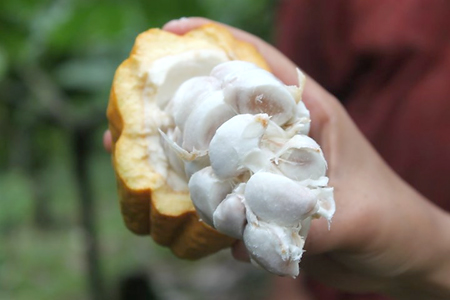
We began with freshly opened pods, one of the CCN-51 variety, and another of Nacional. CCN-51 is Ecuador’s hybrid cacao, and Nacional is Ecuador’s native variety, more of which you can read about here and here. The difference in taste of the mucilage from the two varieties is absolutely noticeable. CCN-51, while having a delicious pulp, is not nearly as fruity or complex as the Nacional pulp. Nacional has a much fruitier, robust flavor with a more complex profile.
We moved on from there to some chocolate liquors, or pastes, made from fermented beans which have been roasted and ground, but with no sugar added. This is the first step in transforming beans into chocolate after winnowing and roasting have been performed.
One of the guests, the General Manager from Ecuatoriana de Chocolates, as well as Rosita, concurred that proper post-harvest treatment and fermentation are the most important parts of getting a top qualtity chocolate. That is, if we break down in importance the components of chocolate making and rank them, of highest importance would be quality of beans. The quality of beans probably contribute 70% to 80% of flavor. Another 15% to 20% would go to proper roasting, and the final 5% to 10% proper refining and conching.
While I’ve seen chocolate review websites that describe chocolate flavors as varied and wild as “old shoe leather, turpentine, juniper, sweetened condensed milk, roses, old socks, tree bark” and other ridiculous flavors, I don’t think any of these really apply to describing chocolate.
Rosita limited her flavors to those you might find in beans, chocolate liquor, or finished chocolate from real sources of contamination, as well as other flavors to look for. We focussed primarily on identifying off flavors. Some I didn’t know about were jute-as a result of fermenting beans in jute sacks or leaving jute sacks on top of fermenting beans for too long-and I have seen this in the field. Gasoline or fuel flavors-from improperly storing chocolate near fuel sources. Metallic flavors from storing beans in metal containers or fermenting them in a metal container. Finally, we were asked to rate for floral, fruity, astringency, mold, and over-fermentation.
Ideally, the best way to go about training your palate is to learn to recognize off flavors first, and once that part is done, move on to looking for and learning to recognize good flavors.
Post By: Jeffery Stern
If you’d like to read more about Jeffery Stern’s experiences, head on over to his blog where he discusses cacao, living in Ecuador, and working in the industry.