
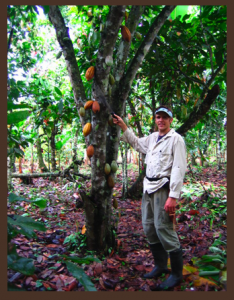
As the weather in Boston turns cold, I reminisce fondly of my time in the tropics.
For two years, I worked with cacao growers in Ecuador, the cradle of some of the highest quality cacao in the world. Cacao arriba, from the tributaries to the River Guayas in Ecuador, was sought after for many years in the late 1800s and early 1900s, creating a cacao boom in the country. Today, Ecuador ranks #7 in cacao producing nations but #1 in cacao fino de aroma. “Fino de aroma” indicates variety (not forestero), climate and soil (moist and rich in magnesium), and the manner in which it is cultivated (poly-culture plantations planted along with fruit trees, plantains, and bananas). This treatment lends the cacao many fruity and floral undertones in its taste, and is generally considered of higher quality then the cacao commodity bought on the market. It is these qualities that have spurred the marketing of chocolates by origin.
There is a move now in Ecuador: farmers are changing their cacao forests into banana plantations. Reasons for this are three-fold. One is that banana barons have done very well over the years and their wealth is the envy of the lower class. Another reason is because Ecuador’s banana industry is so well developed there is added support for these growers and easier market access. The third is that cacao is plagued by a myriad of fungal infections from monilla to escoba de bruja (or witches broom) which can reduce production  by up to 80% and are difficult to treat. This migration puts the economy of Ecuador at risk because it is so reliant on a single crop.
It’s hard work, going into the fields with a machete and palanca (a bamboo pole with a blade attached to the end). The harvesting tasks are divided in two: one team will “tumbar”, dropping the pods from the tree, and the other team will “recojer”, open the pods and collect the white mucilaginous fruit inside. If you are lucky you will have a “burro” along for the trip to carry the heavy sacks out of the forest.
I think back fondly of my days working in the cacao fields, but I do not envy the precarious position the cacao farmers are in, cultivating cacao to feed their families. If you would like to hear more about the chocolate process please leave a note here, as well as what topic you would like to hear more about.
The cacao tree and fruit?
Fermentation and quality?
Exports and Politics?
Blog post by: Miles Masci